How to Evaluate a Long-Term Care Pharmacy: A Decision Guide for Administrators

Choosing a long-term care pharmacy partner is one of the most consequential operational decisions a LTC Administrator makes. The right pharmacy quietly enables your facility to run well. The wrong one generates friction that touches every shift, every nurse, and ultimately every resident.
And yet, many facilities end up with their current pharmacy almost by default — through an acquisition, a referral from a management company, or a contract that just kept renewing. If you’ve never done a formal evaluation of your pharmacy relationship, or if you’re overdue for one, this guide is a practical starting point.
Why the stakes are higher than most administrators realize
Your pharmacy touches your facility every single day. Unlike vendors you interact with quarterly, your LTC pharmacy is embedded in daily operations — medication passes, after-hours calls, new admissions, order clarifications, controlled substance management, and monthly consultant reviews.
The consequences of a poor pharmacy relationship show up in measurable ways. According to a report from the Agency for Healthcare Research and Quality (AHRQ), adverse drug events are among the most common and costly types of medical errors in post-acute care settings, contributing to billions of dollars in preventable hospitalizations annually. For individual facilities, those events translate directly into survey risk, rehospitalization penalties, and staff burnout.
When the relationship is working, good pharmacy partnership is nearly invisible. When it isn’t, it becomes a recurring source of stress for your team and a potential safety risk for your residents.
The five areas that matter most in any evaluation
1. Clinical capability — not just dispensing
There’s a meaningful difference between a pharmacy that fills orders and one that provides genuine clinical partnership. For LTC facilities, you need the latter.
Clinical capability means a consulting pharmacist who conducts substantive monthly medication regimen reviews (MRRs) — not just a compliance signature. It means pharmacists reachable for real clinical questions about drug interactions, dosing, and formulary alternatives. It means proactive intervention, not reactive filling.
Ask any pharmacy you evaluate: When was the last time your consulting pharmacist recommended a change that improved a resident outcome? A strong partner will have a specific answer.
“A dispensing pharmacy is reactive by design — it responds to orders. A clinical partner is proactive. They review medication regimens before problems surface, flag interactions before they reach a resident, and call the prescriber when something doesn’t look right. A true pharmacy partner identifies issues before they lead to problems.”
— Francis Rubino, Pharmacist & Friendship Pharmacy CEO
2. Responsiveness — with specifics
Every pharmacy will tell you they’re responsive. Press for specifics. What is the average response time for an urgent after-hours call? Is there a live pharmacist available at 2am, or an answering service? What’s the escalation protocol for a delivery error discovered on a holiday or the weekend?
Responsiveness in LTC isn’t a nice-to-have. Your residents don’t stop having medical needs after business hours, and your nurses shouldn’t be left without clinical support when emergencies arise.
3. Technology and eMAR integration
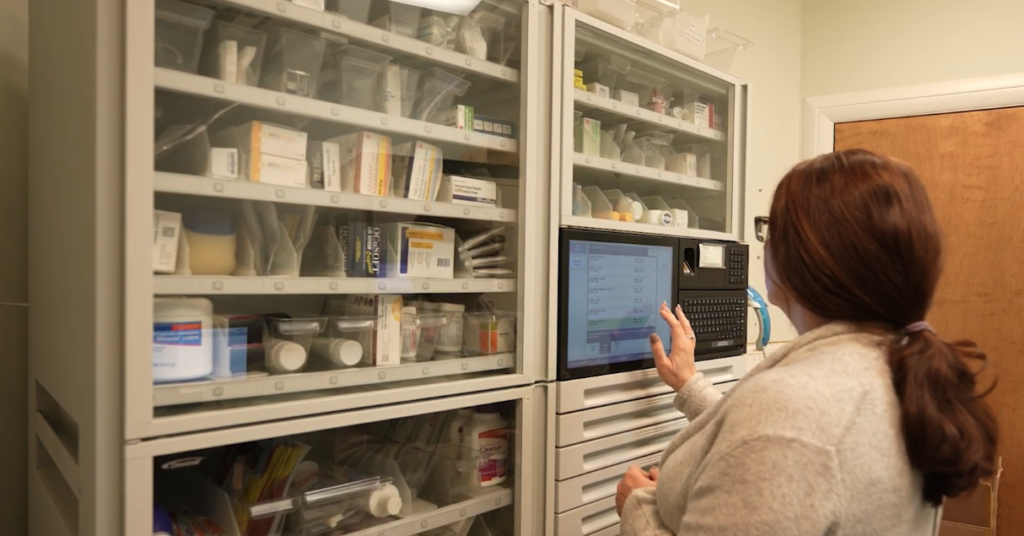
eMAR integration has become table stakes for LTC pharmacy — but not all integrations are equal. Ask how the pharmacy handles order transmission errors, how formulary updates are communicated, and whether their system proactively alerts nursing staff or requires manual follow-up. Automated dispensing cabinet support and telepharmacy capabilities are worth asking about as well.
4. Local presence and accountability
This is where national chains and regional independents diverge most clearly. A local pharmacy partner means shorter delivery windows, a pharmacist who knows your building and your census, and accountability that’s personal rather than institutional.
“The difference between a local pharmacy partner and a distant one shows up every single day. When your pharmacist knows your processes, knows your staff by name, and is willing to walk through the door whenever you need them, everything runs more smoothly. Problems get resolved faster, your nurses feel supported, and you spend a lot less time managing the relationship. It just works.”
— Kim Ratliff, Director of Nursing, Wesley Enhanced Living
For Philadelphia-area facilities specifically, working with a regionally rooted pharmacy also means same-day delivery capability and faster resolution of urgent needs — without routing through a regional service center.
5. Regulatory support
Your pharmacy partner should be actively helping you prepare for and navigate CMS surveys, not leaving your team to manage compliance alone. This includes supporting your antibiotic stewardship documentation, GDR requirements for psychotropic medications, and Five-Star quality measure tracking tied to medication management.
Potential red flags to ask about
- High pharmacy staff turnover. Relationship continuity matters in LTC. If you’ve had multiple account reps or consulting pharmacists in two years, consistency is unlikely to improve.
- Reactive-only communication. If the only time you hear from your pharmacy is when you call them, they’re functioning as a vendor, not a partner.
- Vague answers to specific questions. A confident pharmacy will answer “what’s your after-hours response time?” with a number — not a paragraph about their commitment to service.
- Consultant visits that feel like checkboxes. Monthly MRRs should generate real recommendations. If the reports are identical month over month, the review isn’t happening in any meaningful way.
Questions to bring into any evaluation conversation
- Walk me through your process when a new resident is admitted from a hospital discharge.
- What does after-hours support look like — specifically?
- How many facilities does your consulting pharmacist cover, and how much time do they spend on-site at each?
- Describe a time you caught a medication error before it reached a resident.
- How do you support facilities during and after a CMS survey?
The specificity of the answers to these questions will tell you most of what you need to know.
A note on switching costs
One reason facilities stay with underperforming pharmacies is the perceived difficulty of switching. It’s a legitimate concern — transitions require careful medication reconciliation, and timing matters. But a capable pharmacy partner will manage that transition proactively, making the process far smoother than most administrators expect.
“The number one thing we hear from administrators who’ve been thinking about switching is ‘we just don’t have the bandwidth to deal with a transition right now.’ I understand that. And it’s why it’s important to ask a potential partner to explain their process and present to you a detailed transition plan. We manage the end-to-end transition — the reconciliation, the profile builds, the staff communication. By the time we go live, your nurses barely notice the change. What they do notice is everything that gets better afterward including more time to focus on patient care.”
— Francis Rubino, Pharmacist & Friendship Pharmacy CEO
The short-term complexity of switching is almost always outweighed by the long-term operational improvement. If you’d like to talk through what a transition would look like for your facility, we’re happy to walk through it — no commitment required.
Have more questions? We’re here to help. Our team is available to answer your questions, walk you through our transition process, and recommend additional ways to ensure a proper evaluation so you make the right decision on a pharmacy partner.
Friendship Pharmacy is a third-generation, family-owned long-term care pharmacy serving assisted living, skilled nursing, memory care, and rehabilitation facilities in the Greater Philadelphia area. Contact us or visit friendshippharmacy.com.