The Top 5 Benefits of On-Site Medication Dispensing for Long-Term Care Facilities
Medication management is one of the most complex and high-stakes responsibilities in a long-term care facility. For Directors of Nursing, it touches every shift: ensuring the right medication reaches the right resident at the right time, managing documentation, handling after-hours needs, and keeping nursing staff supported when questions arise.
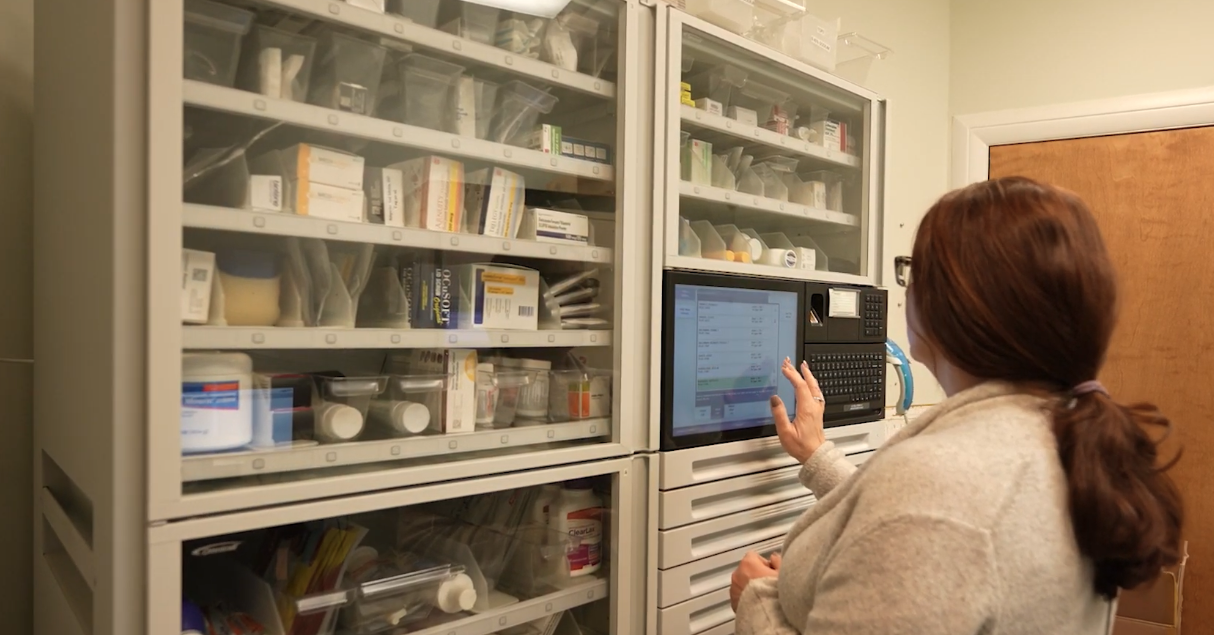
On-site medication dispensing — through automated dispensing cabinets (ADCs) stocked and managed in partnership with your LTC pharmacy — changes that equation in meaningful ways. Consider some of the data points and benefits of utilizing on-site medication dispensing to support your team.
1. Faster access to medications when residents need them
Traditional delivery-dependent models require facilities to anticipate medication needs in advance. When a new order is written after hours, or a medication runs out unexpectedly, nursing staff are left waiting — or improvising.
On-site dispensing puts a curated inventory of commonly needed medications directly in the facility, accessible immediately when a clinical need arises. For new admissions, PRN medications, and urgent order changes, the difference between waiting hours for a delivery and accessing a medication in minutes is not a small one.
“The benefits of having 85%-90% of our medication on-site is invaluable. It allows us to expedite prescription delivery times, especially during initial admission spikes. The technology combined with Friendship Pharmacy’s quick response times, has reduced delivery times from hours to minutes.”
— Kim Ratliff, Director of Nursing @ Wesley Enhanced Living
2. Measurable reduction in medication errors
Dispensing errors — the wrong drug, wrong dose, or wrong patient — are more likely to occur when medications are manually sorted, relabeled, or transferred between containers. Automated dispensing systems reduce that manual handling significantly.
A study published in the American Journal of Health-System Pharmacy found that facilities using automated dispensing cabinets experienced a significant reduction in medication dispensing errors compared to traditional manual systems. Other research has linked ADC adoption in post-acute settings to reductions in adverse drug events and associated nursing time spent on error resolution.
For Directors of Nursing managing stretched nursing teams, fewer errors means fewer incident reports, fewer physician calls, and fewer hours spent on corrective documentation.
“Human error in medication dispensing almost always traces back to the same root cause: too many manual touchpoints. Every time a medication is manually sorted, re-labeled, or transferred between containers, you’ve introduced an opportunity for something to go wrong. Automated dispensing eliminates most of those touchpoints. The result isn’t just fewer errors — it’s a nursing team that isn’t constantly firefighting and a facility that’s in a much stronger position when a surveyor walks through the door.”
— Francis Rubino, Pharmacist & Friendship Pharmacy CEO
3. Better controlled substance management
Controlled substance accountability is one of the most time-intensive and compliance-sensitive areas of LTC medication management. Manual count discrepancies, documentation gaps, and chain-of-custody errors create significant exposure during CMS surveys.
On-site dispensing systems provide a closed-loop process for controlled substances: access is role-restricted, every transaction is logged automatically, and discrepancy alerts surface in real time rather than at the end of a shift. This removes much of the manual burden from nursing staff while simultaneously strengthening the documentation trail auditors look for.
Facilities that have moved to automated controlled substance management consistently report fewer count discrepancies and faster resolution when questions do arise.
4. Reduced nursing time spent on medication logistics
Time nursing staff spend chasing down medications, calling the pharmacy, or managing delivery discrepancies is time not spent with residents. It’s a straightforward equation — but one that’s easy to underestimate until you start measuring it.
According to research from the Institute for Safe Medication Practices (ISMP), nursing staff in long-term care settings spend a disproportionate amount of their shift managing medication-related logistics rather than direct patient care. On-site dispensing, particularly when integrated with eMAR systems, eliminates many of those friction points by making inventory visible, access immediate, and documentation automatic.
“In this staffing environment, anything you can do to reduce unnecessary burden on your nursing team matters. On-site dispensing was one of the best operational decisions we made — not just for efficiency, but for morale. When your staff isn’t constantly managing pharmacy logistics, they’re calmer, they’re more focused, and honestly, they’re happier. That’s not a small thing when you’re trying to retain good nurses.”
— Director of Nursing, Wesley Enhanced Living
5. Stronger regulatory positioning
CMS survey activity in LTC is active and intensifying. Medication management deficiencies — including storage, access, documentation, and administration errors — are consistently among the most cited findings in skilled nursing surveys.
On-site dispensing systems create a documentation infrastructure that supports survey readiness by default. Access logs, transaction histories, and automated alerts provide the kind of real-time visibility that manual systems simply can’t replicate. Facilities with well-implemented dispensing programs tend to enter surveys with greater confidence and exit them with fewer medication-related citations.
The pharmacy partner makes the difference
On-site dispensing is only as effective as the pharmacy managing it. The cabinet is hardware — the clinical value comes from a pharmacy team that actively monitors inventory, responds to restocking needs, integrates with your eMAR, and provides clinical support when your nursing staff has questions.
At Friendship Pharmacy, on-site dispensing is one part of a broader clinical partnership model. We don’t just stock a cabinet and walk away — we monitor usage patterns, flag potential issues, and stay in close contact with the nursing teams we support.
If you’re evaluating whether on-site dispensing is right for your facility, we’re happy to walk through what implementation looks like and what outcomes facilities similar to yours have experienced.
Friendship Pharmacy is a third-generation, family-owned long-term care pharmacy serving assisted living, skilled nursing, memory care, and rehabilitation facilities in the Greater Philadelphia area. Contact us or visit friendshippharmacy.com.